

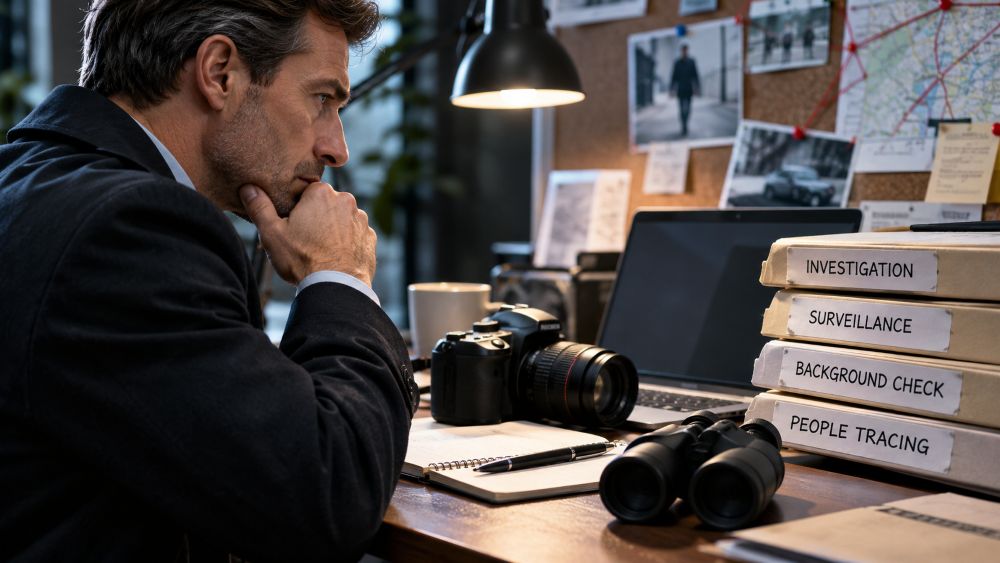
There are moments in life when something simply doesn't add up. Perhaps a business partner's explanation keeps changing, an important person has disappeared without leaving contact details, or you're dealing with a personal situation where the truth seems frustratingly out of reach.
You have questions. What you don't have is reliable evidence.
This is where a professional private investigator can make a meaningful difference. Rather than relying on assumptions, rumours, or incomplete information, an experienced investigator works to establish facts through lawful research, discreet enquiries, and carefully documented findings.
Across the UK, individuals, businesses, and legal professionals turn to investigative services for many different reasons. Some situations involve financial concerns or suspected fraud. Others are deeply personal.
Whatever the circumstances, the objective is usually the same: finding out what is really happening.
What Does a Private Investigator Actually Do?
A private investigator is a professional who gathers information, examines circumstances, and helps clients establish facts that may otherwise be difficult to uncover.
Contrary to what television dramas suggest, professional investigation rarely involves dramatic confrontations or elaborate disguises. Much of the work requires patience, attention to detail, analytical thinking, and a thorough understanding of legal boundaries.
Depending on the assignment, investigative work may involve:
• Locating missing individuals or tracing people who have lost contact.
• Conducting lawful surveillance to establish patterns of activity.
• Investigating suspected fraud or dishonest business practices.
• Performing background enquiries and due diligence.
• Gathering evidence relevant to civil disputes or legal proceedings.
• Examining concerns involving employee misconduct.
• Supporting solicitors with research and fact-finding.
An important distinction is that private investigators do not have the same legal powers as police officers. They must operate within applicable laws, including privacy and data protection requirements.
A reputable professional understands these limitations and explains what can realistically be achieved before accepting an assignment.
Five Situations Where Hiring a Private Investigator Makes Sense
1. When You Need to Locate Someone
Losing contact with someone can happen for countless reasons.
A former business associate may have moved without providing a forwarding address. A family member might have disappeared from your life years ago. Perhaps you're trying to locate someone connected to an unresolved legal matter.
Finding people is not always as simple as searching their names online.
Professional tracing investigations may combine publicly available records, legitimate databases, historical information, and other lawful research methods.
A skilled private investigator can assess the available details, identify promising leads, and determine whether locating the individual is realistically possible.
Of course, tracing services must respect privacy and safeguarding concerns. Finding someone's whereabouts does not automatically entitle a client to receive their private address or contact information.
2. When You Suspect Business Fraud
Imagine discovering inconsistencies in your company's financial records.
At first, they appear relatively minor. A missing invoice here. An unusual payment there. Then another discrepancy emerges.
You begin asking questions, but the answers only create more uncertainty.
Suspected financial misconduct is one reason businesses consult professional investigators.
An investigation may help establish whether there are legitimate explanations for unusual transactions, identify relevant records, or uncover evidence that warrants further examination.
For company directors, obtaining reliable information before making accusations can be particularly important.
An unsupported allegation may damage professional relationships or expose a business to unnecessary legal risks.
3. When Personal Circumstances Raise Difficult Questions
Personal investigations often involve emotionally sensitive situations.
Someone may suspect that a partner is being dishonest. Another person might be concerned about unexplained behaviour affecting a family relationship.
In these circumstances, emotions can make objective decisions difficult.
A professional investigator can explain which enquiries are lawful, proportionate, and appropriate.
However, not every suspicion justifies surveillance or intrusive investigation. Ethical professionals should assess the client's purpose and refuse assignments involving harassment, stalking, coercive control, or unjustified invasions of privacy.
Sometimes the most valuable service is an honest explanation of what cannot legally or ethically be investigated.
4. When You Need Evidence for a Legal Dispute
Legal disagreements often depend on establishing what happened, when it happened, and whether available evidence supports a particular account.
Solicitors may work with private investigators to locate witnesses, conduct background research, or gather relevant factual information.
The quality of the evidence matters enormously.
Information collected unlawfully or documented poorly may create complications rather than strengthen a case.
Professional investigators therefore need to consider accuracy, confidentiality, recordkeeping, and the lawful handling of personal information throughout their work.
5. When You Need to Verify Important Information
Not every investigation begins with suspicion.
Sometimes you simply need greater confidence before making an important decision.
A business owner considering a new commercial relationship may want to verify publicly available information about a potential partner. A company preparing for a significant transaction might require additional due diligence.
This type of investigation is often preventative.
Discovering inconsistencies before signing a contract can be far less expensive than dealing with the consequences afterwards.
Choosing Private Investigators in the UK: What Really Matters?
Finding an investigation service is relatively easy. Choosing the right one deserves more consideration.
Professional competence, confidentiality, legal awareness, and clear communication should carry more weight than dramatic promises.
When comparing private investigators, pay particular attention to the following qualities.
Relevant experience: An investigator who regularly handles commercial fraud enquiries may not be the best choice for a sensitive family tracing assignment. Ask whether the provider has experience with your particular type of case.
Transparent pricing: Investigation costs depend on the complexity of the assignment, research requirements, travel, and time involved. A trustworthy provider should explain its charging structure and any potential additional expenses.
Discretion: Clients frequently share sensitive personal or commercial information. Clear confidentiality procedures and responsible information handling are essential.
Legal compliance: Investigators should explain how their proposed methods comply with UK law. Be cautious of anyone offering access to private messages, confidential bank records, or protected accounts without lawful authority.
Realistic expectations: No professional can guarantee that every investigation will produce the result a client hopes to discover.
The strongest providers are often those willing to explain limitations rather than promise certainty.
UK Private Investigators: An Established Option for Professional Investigations
For anyone looking for an experienced investigation agency, UK Private Investigators (UKPI) is one provider worth considering.
Established in 1997, the company offers investigative services to private individuals, businesses, and legal professionals throughout the United Kingdom.
Its work covers several areas, including surveillance, people tracing, background checks, corporate investigations, fraud enquiries, and legal support.
One particularly useful aspect of the company's approach is its initial consultation process. Clients can explain their circumstances without needing to know which investigative service they require.
A senior investigator then assesses the situation and discusses the available options, legal considerations, expected costs, and likely outcomes.
The company also emphasises confidential case handling and written reporting, both important considerations when dealing with sensitive information.
For clients who prefer an established agency rather than an individual freelancer, UKPI offers a broad range of services under one organisation.
That does not mean every case requires a comprehensive investigation. Sometimes a straightforward background enquiry or people-tracing assignment may be sufficient.
The right approach depends on the question that needs answering.
How Much Does a Private Investigator Cost in the UK?
One of the first questions prospective clients ask is surprisingly simple:
"How much will it cost to find out the truth?"
Unfortunately, there is no universal answer.
The price of hiring a private investigator depends on several factors, including the nature of the investigation, geographical location, available information, and time required.
A relatively straightforward tracing assignment may involve a fixed fee. Surveillance requiring several investigators over multiple days will naturally cost more.
For example, UKPI advertises people-tracing services from £120 and surveillance from £295 per operative per day.
These figures illustrate how significantly costs can vary between services.
Before committing, clients should request a written quotation that identifies the agreed work, expected deliverables, and any additional charges.
The cheapest option is not necessarily the most economical. Poorly conducted investigations can waste time, produce unreliable information, or create legal difficulties.
What Happens After You Hire an Investigator?
For someone who has never contacted an investigation agency, the process can feel intimidating.
In practice, it should be straightforward.
First comes a confidential conversation. The client explains the circumstances, provides relevant information, and identifies what they hope to establish.
Next, the investigator evaluates the request.
Is there a lawful reason to investigate? What information is already available? Which methods would be proportionate? What are the realistic chances of obtaining useful findings?
Once the scope and costs are agreed, the investigation can begin.
Depending on the assignment, the work may involve research, document examination, interviews, or lawful observation.
Finally, the client receives the findings, often in a written report.
Importantly, a professional report should distinguish between verified facts, reasonable interpretations, and information that could not be confirmed.
That distinction is essential when the findings may influence legal, financial, or personal decisions.
Frequently Asked Questions About Private Investigators
Is hiring a private investigator legal in the UK?
Yes. Hiring a private investigator is legal in the United Kingdom, provided the investigation is conducted lawfully. Investigators must respect applicable privacy, data protection, harassment, and other relevant laws.
Can private investigators find missing people?
Professional investigators can assist with legitimate people-tracing enquiries using lawful research methods. However, success depends on available information, individual circumstances, and privacy considerations.
Can a private investigator obtain evidence for court?
Investigators may gather information relevant to legal proceedings. Whether particular evidence is admissible or persuasive depends on how it was obtained, its reliability, and the applicable legal rules.
Are private investigation services confidential?
Reputable agencies generally treat confidentiality as a central part of their service. Clients should still ask about data handling, information retention, and the circumstances in which disclosure may be legally required.
How long does a private investigation take?
Some enquiries may be completed within a few days, while complex investigations can take weeks or longer. The timeframe depends on the scope of work, available leads, and any unexpected developments.
What information should I provide before an investigation?
Start with the relevant facts, documents you are lawfully entitled to share, important dates, and a clear explanation of what you need to establish. Avoid speculation where possible.
Final Thoughts: Reliable Answers Begin With the Right Questions
Uncertainty can be exhausting, especially when it affects your family, finances, business, or future.
But acting on suspicion alone can sometimes make a difficult situation worse.
A professional private investigator offers something more valuable than speculation: a structured, lawful approach to establishing facts.
Whether you're trying to locate someone, investigate suspected misconduct, verify important information, or support a legal matter, choosing experienced private investigators can help you approach the situation with greater clarity.
The most important first step isn't necessarily launching an investigation.
It's understanding exactly what you need to know, why that information matters, and whether it can be obtained responsibly.
Because sometimes, getting a clear answer changes everything.